
Session 3 of 5 · about 10–15 minutes
The First Gospel: Genesis 3:15 and Revelation 12
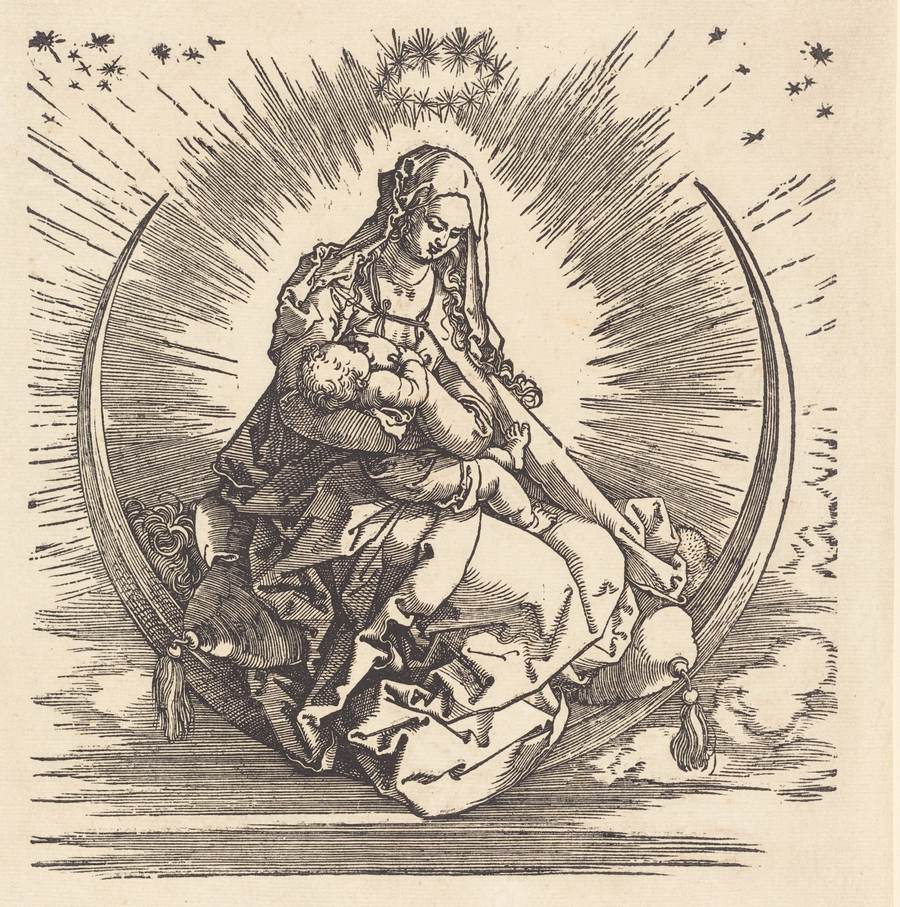
Read first
- Genesis 3:14–15: the promise inside the curse
- Revelation 11:19–12:17: the woman, the child, and the dragon (11:19 is on the chapter 11 page)
- Galatians 4:4–5: "God sent his Son, born of a woman"
- John 2:1–5 and John 19:25–27: Jesus calls his mother "Woman"
- Luke 1:38: "May it be done to me according to your word"
Teaching
Even the punishment in Genesis 3 has a promise hidden inside it. God says to the snake:
"I will put enmity between you and the woman, and between your offspring and hers; They will strike at your head, while you strike at their heel." (Gn 3:15)
A wound to the heel hurts. A blow to the head is fatal. The serpent will wound the woman's offspring, but her offspring will crush him.
The Church calls this verse the Protoevangelium, the "first gospel": "the first announcement of the Messiah and Redeemer, of a battle between the serpent and the Woman, and of the final victory of a descendant of hers" (CCC 410). St. Irenaeus and other Church Fathers read it "as the first promise of a redeemer for fallen humankind, the protoevangelium" (NABRE note on Gn 3:15). The same note explains that "they" refers to the woman's "offspring," all her descendants, and that the verse is read as referring to Christ.
Who is the woman? Christian tradition sees Jesus as the "New Adam" and Mary as the "new Eve" (CCC 411). Watch the pattern:
- Eve listened to the serpent. Mary listened to the angel: "May it be done to me according to your word" (Lk 1:38).
- The early Fathers put it in one line, quoted in the Catechism: "The knot of Eve's disobedience was untied by Mary's obedience." (CCC 494)
- Jesus addresses his mother as "Woman" at Cana and at the Cross (Jn 2:4; 19:26), the same word as in Genesis 3:15.
St. John Henry Newman showed that this "Second Eve" teaching goes back to the earliest Fathers of the Church. Summing up what they taught about Mary, he wrote simply: "She is the Second Eve." (Newman, Letter to Pusey, ch. 3, Newman Reader) Father's reading for this lesson comes from a collection of Newman's Marian writings, The Mystical Rose (Scepter, 1996), pp. 8–9.
Get The Mystical Rose (Scepter Publishers).
Revelation 12 shows the promise fulfilled. Right after "the ark of his covenant could be seen in the temple" (Rv 11:19), John sees "a woman clothed with the sun, with the moon under her feet, and on her head a crown of twelve stars" (12:1). She gives birth to a son "destined to rule all the nations" (12:5). The dragon is named outright: "the ancient serpent, who is called the Devil and Satan" (12:9). He is thrown down, and the victory is won "by the blood of the Lamb" (12:11). Genesis 3:15 has come full circle: the woman, her offspring, the serpent, and his defeat.
The NABRE note says the woman "symbolizes God's people in the Old and the New Testament": Israel, who gave birth to the Messiah, and the Church (note on Rv 12:1–6). Catholic tradition also sees Mary here, the Mother of the Messiah and the image of the Church. The Church reads this very passage at Mass on the Solemnity of the Assumption (USCCB readings, Aug 15, 2026). The Catechism connects Revelation 12 to Mary too: the dragon "pursued the woman" but had no hold on her (CCC 2853).
Catechism
- CCC 410–412: the Protoevangelium; the New Adam and the new Eve
- CCC 487, 489, 494: Mary in God's plan
- CCC 2853: the dragon, the woman, and Christ's victory
If you grew up evangelical…
Mary can be the hardest part of Catholicism for someone coming from an evangelical church, and that's okay. You may have been told that Catholics put Mary in Jesus' place. Here is what the Church actually teaches: "What the Catholic faith believes about Mary is based on what it believes about Christ" (CCC 487). Her role "in no way obscures or diminishes this unique mediation of Christ, but rather shows its power" (CCC 970).
Notice too where you've been reading today: Genesis, Luke, John, Galatians and Revelation. Catholic teaching on Mary starts in the Bible you already love. Everything about Mary leads us to her Son.
Reflect
- Genesis 3:15 locates a promise inside a punishment. Where has God hidden a promise inside something painful in your life?
- Eve doubted; Mary trusted. What would "May it be done to me according to your word" look like on your next shift?