
Session 2 of 5 · about 10–15 minutes
The Fall of the Angels (and Tolkien's Melkor)
Watch first
The Creation of Arda (The Ainulindalë) | Tolkien Explained
Watch on YouTubeRead first
- Genesis 3:1–5: the tempter's offer: "you will be like gods"
- John 8:44: "He was a murderer from the beginning"
- 1 John 3:8: "the Son of God was revealed to destroy the works of the devil"
- Romans 8:28: "all things work for good for those who love God"
Teaching
More than a serpent, behind the snake's voice in Genesis 3 is someone older. The Catechism teaches: "Behind the disobedient choice of our first parents lurks a seductive voice, opposed to God" (CCC 391). Scripture and Tradition identify him as a fallen angel, Satan, the devil.
Here is the core of CCC 391–395 in five points:
- Created good. "The devil and the other demons were indeed created naturally good by God, but they became evil by their own doing." (CCC 391) God made nothing evil.
- A free total, "no." Their fall was "the free choice of these created spirits, who radically and irrevocably rejected God and his reign" (CCC 392). The same pride echoes in the tempter's offer: "You will be like God."
- Why there is no second chance for them. It is not that God's mercy runs out. Their choice is final: "There is no repentance for the angels after their fall, just as there is no repentance for men after death." (CCC 393)
- His work is lies and death. Jesus calls him "a murderer from the beginning" (Jn 8:44; CCC 394). He even tried to turn Jesus from his mission, in the desert (Mt 4:1–11; Lk 4:1–13) and later through Peter: "Get behind me, Satan" (Mt 16:23).
- He is only a creature. Satan's power "is, nonetheless, not infinite. He is only a creature… He cannot prevent the building up of God's reign." (CCC 395)
A story that helps: Tolkien's Melkor. J.R.R. Tolkien was a devout Catholic, and the opening of The Silmarillion, the "Ainulindalë" ("Music of the Ainur"), tells of creation as a great song. Here it is in brief, in our own words (Father's outline, summarizing pp. 16–17).
The Ainur, mighty spirits, sing a great Music that the One, Ilúvatar, has given them. Melkor, the most gifted of them, wants more power and glory for himself. He weaves thoughts "of his own" into the song, and discord spreads. Ilúvatar answers with new themes. In the end he declares that every theme comes from him, and that anyone who tries to bend the Music against him will only become his instrument in devising "things more wonderful, which he himself hath not imagined." (Tolkien, The Silmarillion, "Ainulindalë," pp. 16–17)
That is CCC 391–395 in story form: a creature made good, a proud free choice, real damage, and a God whose providence is never defeated. Paul says it plainly: "all things work for good for those who love God" (Rom 8:28). The Church adds that God "knows how to derive good" even from moral evil, "But for all that, evil never becomes a good." (CCC 311–312)
Want to read it yourself? The Silmarillion (HarperCollins). Page numbers vary by edition. The passage is near the start of the "Ainulindalë."
Catechism
- CCC 391–395: the fall of the angels
- CCC 311–314: providence and the scandal of evil
- CCC 2851–2853: "deliver us from evil." Here "evil is not an abstraction, but refers to a person, Satan" (CCC 2851).
If you grew up evangelical…
You may have heard a lot about "spiritual warfare," and you may wonder if Catholics take the devil seriously. They do. Every Our Father ends with "deliver us from evil," and the Catechism says that petition means a real person, the Evil One (CCC 2851).
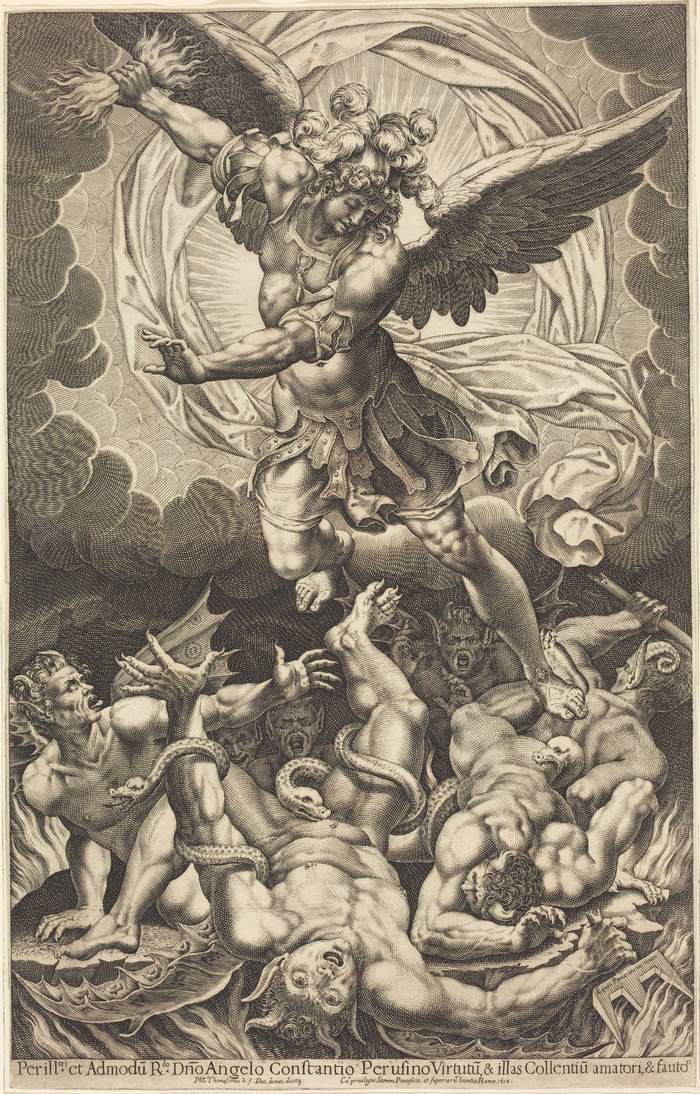
The Catholic emphasis is on keeping him in his proper place/proportion. He is a creature, not God's equal, and Christ has already won (CCC 395, 2853). As a police officer you also have a heavenly patron in this fight: St. Michael the Archangel, who casts down the dragon in Revelation 12:7–9.
Reflect
- Melkor wanted to make music "of his own" apart from the Giver. Where are you tempted to build a life "of your own" apart from God?
- Have you seen God bring good out of something evil, in your own life or on the job?