
Session 1 of 5 · about 10–15 minutes
The Fall: How Evil Twists the Truth
Watch first
Day 2: The Fall of Adam and Eve — The Bible in a Year (with Fr. Mike Schmitz)
Watch on YouTubeRead first
- Genesis 3:1–20: the temptation, the fall, and God's first questions
- John 8:44: the devil "is a liar and the father of lies"
- 2 Corinthians 11:14: "even Satan masquerades as an angel of light"
Teaching
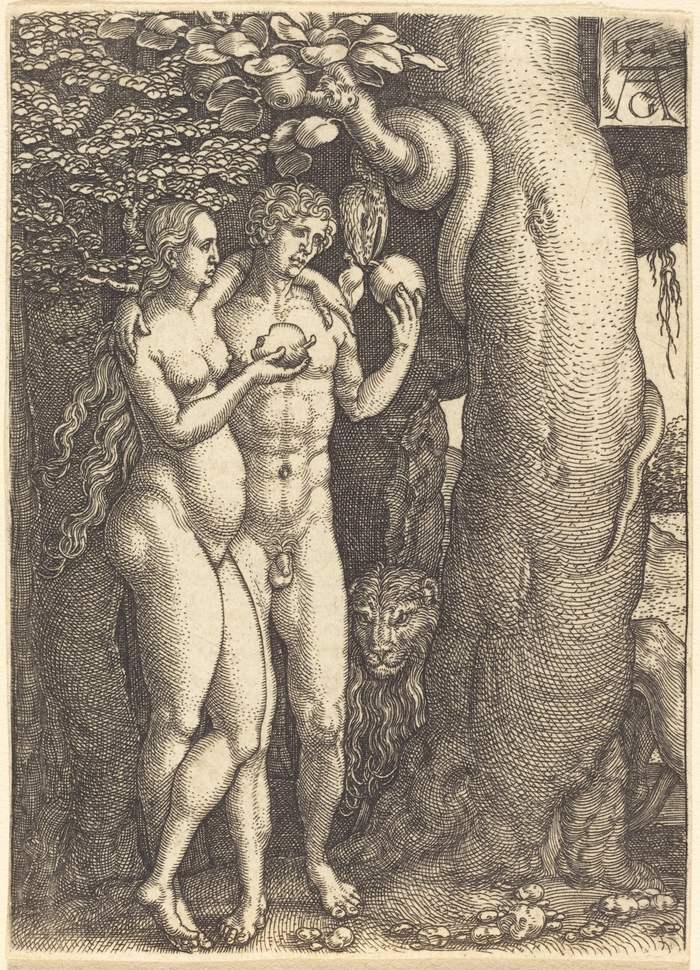
Genesis does not begin with an obvious monstrous attack. It begins with a question: "Did God really say, 'You shall not eat from any of the trees in the garden'?" (Gn 3:1)
Notice the trick. God had said the opposite: they could eat from every tree but one (Gn 2:16–17). The snake doesn't deny God outright. He bends God's words just enough to make God sound stingy.
Next comes a flat lie with a half-truth attached: "You certainly will not die! God knows well that when you eat of it your eyes will be opened and you will be like gods, who know good and evil." (Gn 3:4–5) Well, their eyes are opened, but all they see is their own nakedness (3:7).
This is Fr. De Rosa's main point: evil rarely shows up labeled "evil." It comes as a slight twisting of the truth. Anyone who has worked the street has heard it: "Everybody does it." "Nobody gets hurt." "They had it coming."
Even the pagan philosophers saw this. At his trial in Plato's Apology, Socrates questions his accuser Meletus, and they agree that bad people harm those around them. Then Socrates asks: "Is there anyone who prefers to be injured?" Meletus answers: "Of course not." (Plato, Apology 25d, trans. Harold North Fowler, Perseus Digital Library) Socrates' point is that if I corrupt the people around me, "I am in danger of getting some harm from them" (25e). So no one who sees clearly would choose it.
Socrates' argument runs like this:
- Everyone knows that harming another person harms yourself too.
- No one would deliberately harm himself.
- So something has to twist a person's thinking before he hurts others.
Then the twisting grows. One small bend in the truth leads to another, until something new and corrupted comes out of it. In Genesis 3 the pattern goes: a question, a lie, a grab, hiding, and then blame. "The woman whom you put here with me—she gave me fruit" (3:12). "The snake tricked me" (3:13).
Scripture and the Church go one step beyond Socrates. Sin is not only a mistake in thinking. It is a free choice. The Catechism says sin is "an abuse of the freedom that God gives to created persons so that they are capable of loving him and loving one another" (CCC 387). At the root of the first sin is lost trust: "All subsequent sin would be disobedience toward God and lack of trust in his goodness" (CCC 397).
But hope is not lost. After the fall, God goes looking for the man and calls out: "Where are you?" (Gn 3:9)
Catechism
- CCC 385–390: where evil comes from, and how to read Genesis 3. It "uses figurative language, but affirms a primeval event" (CCC 390).
- CCC 396–401: man's first sin and its consequences. Man wanted to "be like God," but "without God, before God, and not in accordance with God" (CCC 398).
If you grew up evangelical…
You probably grew up loving the Bible, maybe memorizing verses as a kid. Hold onto that. The Church does too, and it quotes St. Jerome: "Ignorance of the Scriptures is ignorance of Christ." (CCC 133)
You may have been taught to read Genesis 1–3 strictly literally, or you may have been told it's "just a story." The Catholic reading is neither. The Church says Genesis 3 "uses figurative language, but affirms a primeval event, a deed that took place at the beginning of the history of man" (CCC 390). The Fall really happened, and the way it is told is rich with symbol.
Reflect
- Where do you hear "Did God really say…?" today, at work, online, or in your own head?
- Think of a time a small rationalization grew into something bigger. What would it have taken to stop it at the first step?