
· 33rd Sunday in Ordinary Time
Multiplying Graces
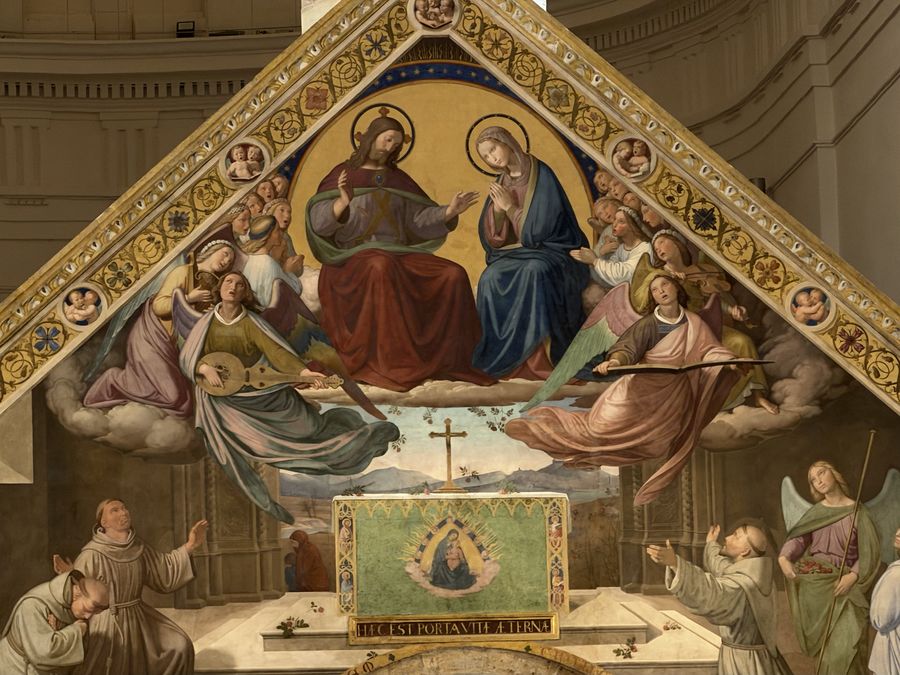
Friends, this past week the Church remembered a great saint, Martin of Tours. As he lay dying, his brothers begged him not to leave them. Martin prayed: “If your people still need me, Lord, I do not shrink from toil: thy will be done.”1
Have you ever heard of someone actually being prepared for the coming of a thief? Of course not… because if you heard him, the thief would avoid your house, not risk it! St. Paul tells us in the second reading that “the day of the Lord will come like a thief at night.”2 The truth is that MOST of us are not fully prepared for the day of judgment. We have not, in union with Jesus, multiplied graces enough to let go of all our attachments to this life.
And that is exactly what the Gospel is about this morning, multiplying graces. A master entrusts his servants with talents, and the ones who love him don’t bury what they’ve been given. “Immediately the one who received five talents went and traded with them, and made another five. Likewise, the one who received two made another two.”3 They multiplied what they received. That’s our work too: not to sit on grace, but to multiply it.
We heard it already in the first reading, in that portrait of the worthy wife: “She obtains wool and flax and works with loving hands.”4 The Church is the bride of Christ, and like a good bride she strives to multiply not flax but grace, to the glory of her heavenly spouse and the good of her children. She does this by administering the power of the keys given her by Christ. The Catechism says indulgences (read, “mercies”) are obtained through the Church who, “by virtue of the power of binding and loosing granted her by Christ Jesus, intervenes in favor of individual Christians and opens for them the treasury of the merits of Christ and the saints.”5
How does this all take shape in a concrete “to do list” kind of a way for you and me? We’ll get there. But first we have to be honest about why we need these indulgences, these mercies. We need them because of what the Church calls purgatory.
The Catechism is very clear, and very consoling: “All who die in God’s grace and friendship, but still imperfectly purified, are indeed assured of their eternal salvation; but after death they undergo purification, so as to achieve the holiness necessary to enter the joy of heaven.”6 That’s not hell. That’s a soul already saved, still being made ready. And the Catechism is equally clear about why: “every sin, even venial [sin], entails an unhealthy attachment to [created things], which must be purified either here on earth, or after death in the state called Purgatory.”7
Let me put it in my own words. When we die, the blinders of sin, the mud obscuring our eyes, ears, and other senses are removed. We are finally able to see and feel things as they truly are. That includes accurately perceiving how much it hurts us to be attached to this world and away from Jesus. St. Paul gave us a preview of this. He says that “while we are at home in the body we are away from the Lord,” and that “we would rather leave the body and go home to the Lord.”8
So we need to dissolve those bonds by sacrifice. After death we no longer have bodies capable of that. The pain we feel has been compared to fire.
Pope Benedict XVI, in his teaching on hope, points to the fire which both burns and saves as Christ himself: “His gaze, the touch of his heart heals us through an undeniably painful transformation ‘as through fire.’” “But it is a blessed pain, in which the holy power of his love sears through us like a flame.”9
Mother Cabrini (whose feast we observed Friday), writing to her Sisters in 1894. She saw those holy souls as doves who would love to fly to the bosom of God, “but, woe to them if no pitying hand severs their chains of fire.” Our prayers, she says, will be “the dew that will quench the flames of Divine Justice.”10 Why fire? Because in purgatory we finally feel, acutely, the tension between our desire for God and the distance still to be covered.
A slightly different or nuanced take comes to us from St. John Henry Newman, in The Dream of Gerontius: his epic poem about a soul going to judgement. The Angel of Purgatory lays the soul down as if to sleep, and says:
Farewell, but not for ever! brother dear, Be brave and patient on thy bed of sorrow; Swiftly shall pass thy night of trial here, And I will come and wake thee on the morrow.11
Newman doesn’t give us a precise clock for that night or purgatory. He agrees with Pope Benedict: purgatory “eludes earthly time-[keeping]—it is the heart’s time.”12 The way I read Newman, the length of that purging sleep differs as our attachments dissolve, though it is imperceptible to us, the sleepers. I rather like that image myself.
So how do we escape it? Or better: how do we help one another through purgatory, and how do we prepare for it now, while we still have bodies capable of sacrifice?
From the beginning, “the Church has honored the memory of the dead and offered prayers in [support] for them, above all the Eucharistic sacrifice.” “The Church also commends almsgiving, indulgences, and works of penance undertaken on behalf of the dead.”13 Newman’s Angel says the same thing, in his own way:
And Masses on the earth, and prayers in heaven, Shall aid thee at the Throne of the Most [High].14
Mother Cabrini is wonderfully practical. Relieve the faithful departed, she says, “by offering for them your Holy Communions, Indulgences, Masses and all satisfactory works.”15
And here is the beautiful part, friends: these sacrifices are for the good of the souls in purgatory and for us. Cabrini tells her Sisters, “You will be doing much to your own advantage if you relieve them,” and that they need have no fear of losing out: “by so doing you will become rich in grace and merits.”16 Pope Benedict puts it simply, hope is always in a sense, communal: “Our hope is always essentially also hope for others; only thus is it truly hope for me too.”17
So here is our homework—a to-do list for you and me, based on the sound doctrine of the saints and the Catechism. Constantly generate graces. Offer the prescribed sacrifices for the dead and for ourselves in Christ: the Mass, Holy Communion, indulgences, prayer, works of mercy and penance.18 Don’t bury the talent. Multiply it. Every Communion you offer, every indulgence you gain, every small sacrifice Jesus magnifies and multiplies, for the dead and for us.
We are still needed by God’s people, living and dead. Like St. Martin, we do not shrink from the toil. Lord, thy will be done.19
Notes
- Sulpitius Severus, Letter III, trans. Alexander Roberts, Nicene and Post-Nicene Fathers, 2nd ser., vol. 11 (1894). Read the letter at CCEL. ↩
- 1 Thess 5:2 (NABRE). Sunday readings are from the Lectionary for Mass, 2nd typical ed. 1 Thessalonians 5:2 · Sunday readings, November 15, 2026. ↩
- Mt 25:16–17 (NABRE). Matthew 25:16–17. ↩
- Prov 31:13 (NABRE). Proverbs 31:13. ↩
- Catechism of the Catholic Church (hereafter CCC), no. 1478. CCC 1478 at vatican.va. ↩
- CCC 1030. CCC 1030 at vatican.va. ↩
- CCC 1472. CCC 1472 at vatican.va. ↩
- 2 Cor 5:6, 8 (NABRE). 2 Corinthians 5:6, 8. ↩
- Benedict XVI, Spe salvi (November 30, 2007), no. 47. Spe salvi at vatican.va. ↩
- St. Frances Xavier Cabrini, “Genoa to New York — September, 1894,” Travels of Mother Frances Xavier Cabrini (Chicago, 1944), 70. Page 70 at archive.org. ↩
- St. John Henry Newman, The Dream of Gerontius, §7, lines 909–912 (Longmans, Green, 1910). Lines 909–912 at Project Gutenberg. ↩
- Benedict XVI, Spe salvi, no. 47. Spe salvi, no. 47. (See also: Newman, The Dream of Gerontius, §3, lines 357–358. Lines 357–358 at Project Gutenberg.) ↩
- CCC 1032. CCC 1032 at vatican.va. ↩
- Newman, The Dream of Gerontius, §7, lines 907–908. Lines 907–908 at Project Gutenberg. ↩
- Cabrini, Travels, 70. Page 70 at archive.org. ↩
- Cabrini, Travels, 70. Page 70 at archive.org. ↩
- Benedict XVI, Spe salvi, no. 48. Spe salvi, no. 48. ↩
- See CCC 1032, 1473, 1479. CCC 1032 · CCC 1473 and 1479. ↩
- Cf. Sulpitius Severus, Letter III, trans. Roberts. See n. 1 above. Read the letter at CCEL. ↩